Certificate of Analysis
Each batch of GHK-Cu undergoes rigorous third-party testing to ensure purity and identity verification. View the full lab report below.
GHK-Cu (Copper Peptide)
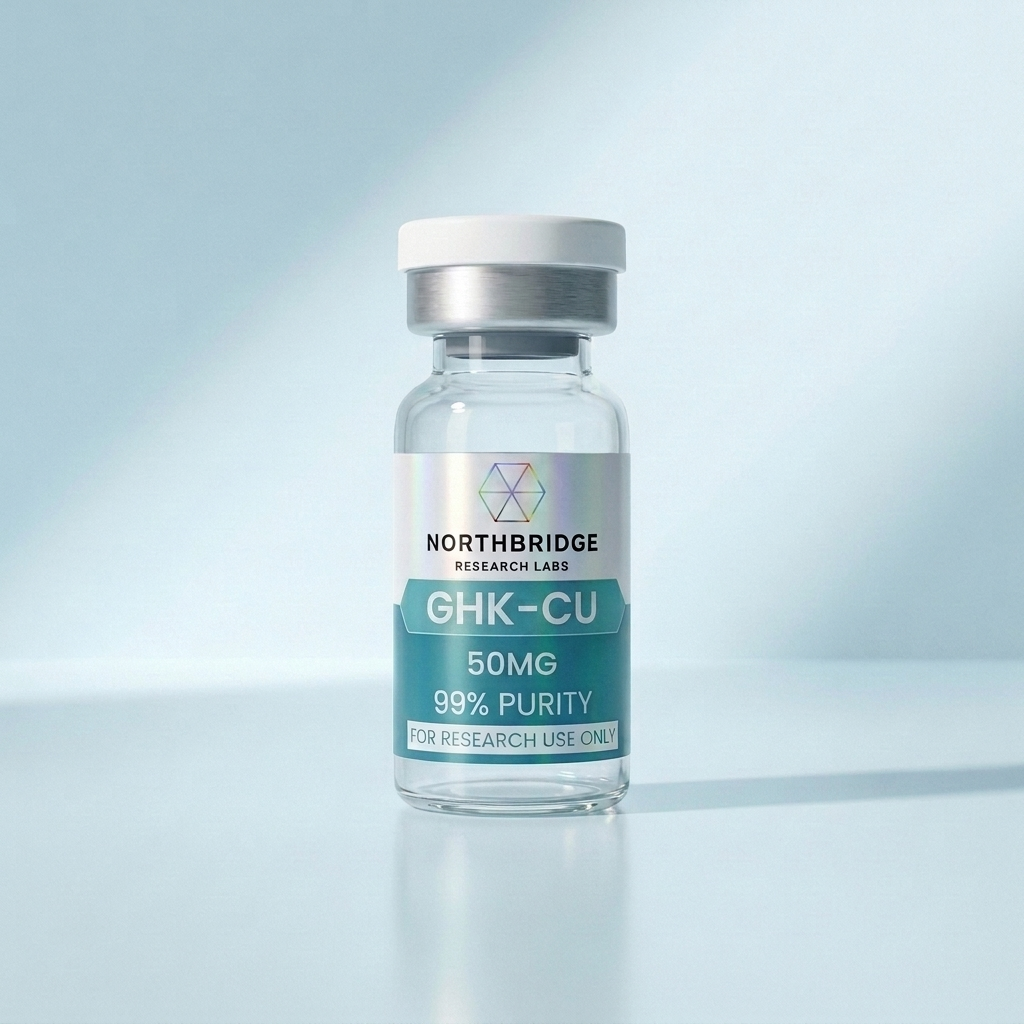
Copper peptide GHK-Cu is a naturally occurring tripeptide with copper binding properties. This research compound is studied for its roles in various biological processes.
99%+
50mg
Bundle & Save
Order before 2 PM EST, ships the same day. Fast, fully tracked, and sent in discreet, secure packaging. Free shipping on orders over $99.
Purity Guarantee. If independent third-party testing doesn't confirm our stated purity standards, you get a full refund plus a free replacement.
For Research Use Only
Intended for in-vitro research only. Not for human consumption. Must be 21+.
Specifications
Certificate of Analysis
Each batch of GHK-Cu undergoes rigorous third-party testing to ensure purity and identity verification. View the full lab report below.
Research background
GHK-Cu Copper Peptide: Gene Expression and Tissue Remodeling
GHK-Cu is a copper-binding tripeptide found in human plasma. A research guide to its copper chemistry, the fibroblast, wound and gene-expression studies behind its reputation, the limits of that evidence, and how to handle a copper complex in the lab.
Overview
Biochemical Characteristics
GHK-Cu forms a stable 1:1 complex with copper(II) ions. The histidine and lysine residues coordinate copper binding, while the glycine provides structural flexibility. This configuration enables optimal copper delivery and biological activity in experimental models.
Research Applications
Pathway / Mechanistic Context
Preclinical Research Summary
Form & Analytical Testing
Mechanisms of Action
Copper Bioavailability - Delivers essential copper ions to tissues and cells for enzymatic functions
Gene Expression Modulation - Affects expression of 4000+ genes related to tissue repair and remodeling
Stem Cell Recruitment - Attracts regenerative cells and fibroblasts to sites of tissue damage
Antioxidant Enhancement - Upregulates superoxide dismutase (SOD), catalase, and glutathione systems
Research Applications
1Skin & Wound Research
Extensive research on dermal biology and wound healing.
Key Research Findings
- Accelerates wound closure in animal dermal wound models
- Stimulates collagen I and III synthesis in fibroblast cultures
- Promotes elastin and glycosaminoglycan production in cell studies
- Reduces scar tissue formation through matrix remodeling in wound models
2Extracellular Matrix Remodeling
Studies on connective tissue biology and matrix protein synthesis.
Key Research Findings
- Upregulates lysyl oxidase for collagen crosslinking
- Enhances proteoglycan synthesis and deposition
- Modulates matrix metalloproteinase activity
- Promotes organized tissue architecture
3Antioxidant & Cytoprotection Research
Investigation of cellular protection mechanisms.
Key Research Findings
- Increases superoxide dismutase expression
- Enhances catalase and glutathione peroxidase activity
- Reduces oxidative damage markers
- Protects cells from free radical injury
Supporting Research & Bibliography
The following peer-reviewed publications support the research applications described above. References are provided for informational purposes to assist researchers in their literature review.
Total references: 4
Note: The information provided is for research reference only. It summarizes published in-vitro, animal and, where cited, human clinical studies of the compound; findings from those studies are not claims about this product. This product is intended for laboratory research purposes only. Not for human or veterinary use.
Research Use Only: This product is intended for laboratory research purposes only. Not for human or veterinary use. By purchasing, you confirm that you are a qualified researcher and will use this product in accordance with all applicable regulations.