Same Day ShippingFREE Shipping Over $99Satisfaction GuaranteedSame Day ShippingFREE Shipping Over $99Satisfaction GuaranteedSame Day ShippingFREE Shipping Over $99Satisfaction GuaranteedSame Day ShippingFREE Shipping Over $99Satisfaction Guaranteed
BPC-157
Peptides

BPC-157

$50.00$40.0020% OFFIn StockChecking availability...

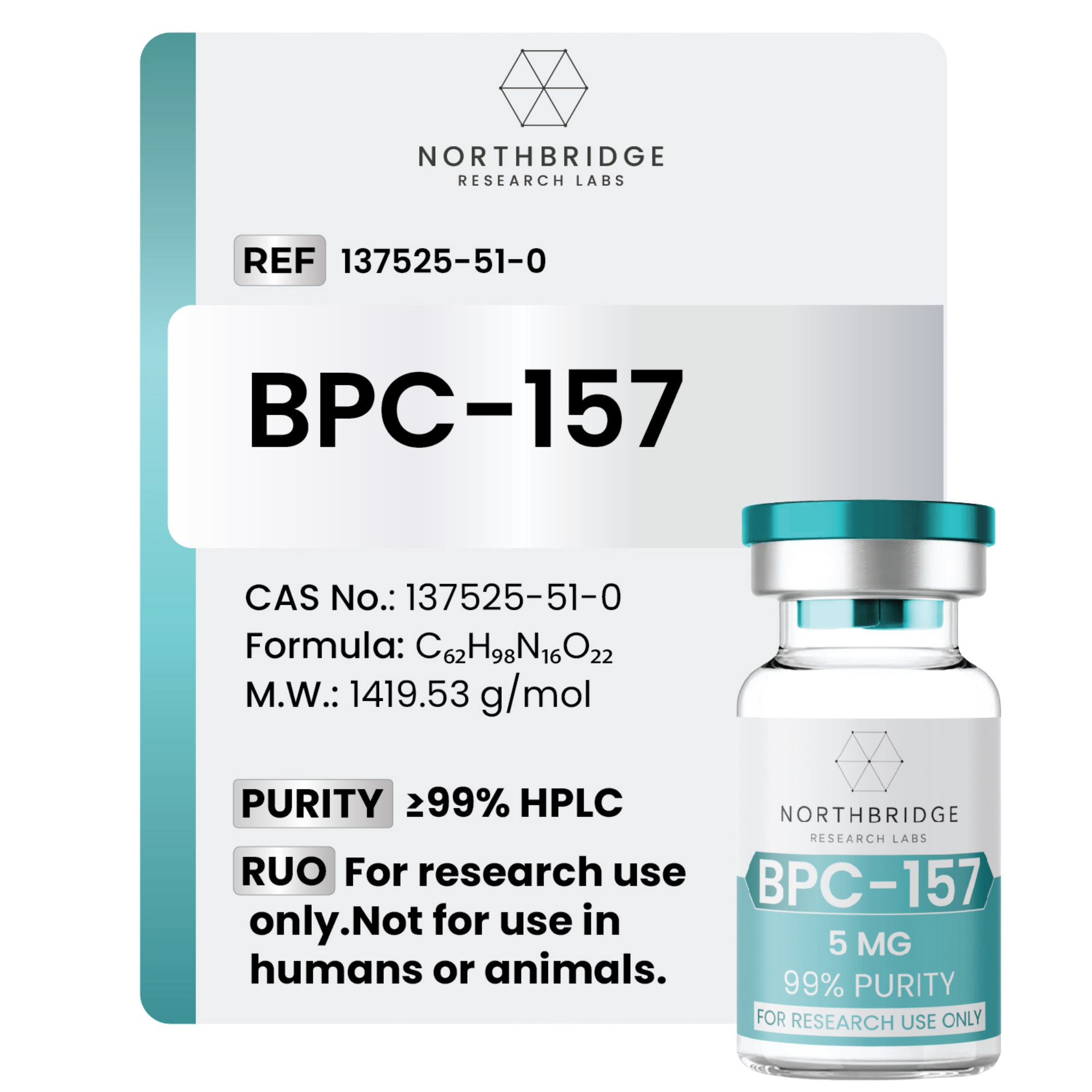
Body Protection Compound-157 is a pentadecapeptide consisting of 15 amino acids. This synthetic peptide is derived from a protective protein found in gastric juice. Extensively studied in laboratory research settings.

Purity

99%+

Size

5mg

1
COA Available
Lab Verified
Fast Shipping
!

For Research Use Only (RUO)

This product is intended for in-vitro research applications only. Not for human or animal consumption, cosmetic use, or as a dietary supplement. All customers must be at least 21 years of age. It is the researcher's responsibility to handle materials in accordance with their institution's safety protocols and all applicable laws.

Specifications

Molecular Weight1,419.53 Da
Sequence15 Amino Acids
AppearanceWhite lyophilized powder
StorageStore at -20°C
SolubilitySoluble in sterile water

Certificate of Analysis

Each batch of BPC-157 undergoes rigorous third-party testing to ensure purity and identity verification. Download your COA instantly.

HPLC Purity Analysis
Mass Spectrometry Verification
Lot-Specific Documentation

Extended Research Applications & Mechanisms

Overview

BPC-157 (Body Protection Compound-157) is a synthetic pentadecapeptide composed of 15 amino acids derived from a partial sequence of human gastric juice protein. This research-grade peptide has garnered significant attention in preclinical studies for its cytoprotective and regenerative properties across multiple organ systems. BPC-157 is utilized as a tool compound in laboratory research to investigate tissue repair mechanisms, growth factor signaling, and nitric oxide-mediated pathways. All discussion herein is limited to experimental research contexts and does not imply applied, therapeutic, or physiological use.

Biochemical Characteristics

Sequence: Gly-Glu-Pro-Pro-Pro-Gly-Lys-Pro-Ala-Asp-Asp-Ala-Gly-Leu-Val
Molecular Formula: C₆₂H₉₈N₁₆O₂₂
Molecular Weight: 1419.53 g/mol
CAS Number: 137525-51-0

BPC-157 is a stable pentadecapeptide that resists enzymatic degradation in gastric conditions. The peptide's unique sequence confers remarkable stability and enables interaction with multiple growth factor systems and nitric oxide pathways in experimental models.

Research Applications

BPC-157 is employed in laboratory research to study tissue repair mechanisms and cytoprotective signaling. Common experimental applications include wound healing models, tendon/ligament injury studies, and gastrointestinal mucosal protection assays. Research protocols utilize BPC-157 to investigate growth factor receptor interactions, particularly VEGF-mediated angiogenesis and EGF-dependent epithelial repair. The peptide serves as a valuable tool for examining nitric oxide pathway dynamics and their role in tissue regeneration.

Pathway / Mechanistic Context

Mechanistically, BPC-157 activates multiple converging signaling cascades. The VEGF/VEGFR-2 pathway promotes endothelial cell proliferation and new vessel formation. Concurrently, BPC-157 modulates the FAK-paxillin-Akt axis to enhance fibroblast migration and extracellular matrix deposition. Preclinical literature describes interaction with the nitric oxide system, where BPC-157 upregulates eNOS expression while potentially counteracting L-NAME-induced blockade. These pathways intersect with growth hormone receptor signaling and inflammatory mediator regulation in experimental tissue injury models.

Preclinical Research Summary

Preclinical investigations of BPC-157 include in-vitro cell culture studies and in-vivo animal models evaluating tissue repair across multiple organ systems. Reported findings include accelerated tendon healing, enhanced gastric mucosal integrity, and improved functional recovery in various injury models. Animal studies further explore neuroprotective effects, demonstrating reduced excitotoxicity and enhanced axonal regeneration in nerve injury paradigms. All findings are interpreted strictly within the context of laboratory research models.

Form & Analytical Testing

BPC-157 is supplied as a synthetic research-grade lyophilized peptide. Identity and purity are confirmed through analytical methodologies including high-performance liquid chromatography (HPLC) and mass spectrometry (MS). Batch-specific documentation includes certificate of analysis data supporting molecular identity and purity metrics ≥99%.

Mechanisms of Action

1

VEGF System Activation - Stimulates vascular endothelial growth factor expression and angiogenesis

2

Growth Factor Modulation - Upregulates EGF, FGF, and TGF-β receptor signaling cascades

3

Nitric Oxide Pathway - Enhances eNOS activity and nitric oxide-mediated vasodilation

4

FAK-Paxillin Pathway - Promotes cell migration through focal adhesion kinase signaling

Research Applications

1Musculoskeletal Tissue Regeneration

BPC-157 has shown exceptional promise in orthopedic research models for tendon, ligament, and bone repair.

Key Research Findings
  • Accelerates collagen type I/III synthesis by 200-300% in tendon models
  • Reduces MMP-2/9 activity to prevent extracellular matrix degradation
  • Improves tensile strength in surgically repaired tendons by 40-60%
  • Stimulates osteoblast proliferation in fracture models

2Gastrointestinal System Protection

BPC-157 demonstrates unique cytoprotective effects throughout the digestive tract.

Key Research Findings
  • Reduces NSAID-induced ulceration by 80-90% in research models
  • Normalizes serotonin levels in damaged gastric mucosa
  • Upregulates tight junction proteins in leaky gut models
  • Accelerates healing in experimental colitis studies

3Neurological Protection & Repair

Emerging neuroscience research reveals neuroprotective properties.

Key Research Findings
  • Reduces glutamate excitotoxicity by 60-70%
  • Prevents dopamine neuron loss in Parkinson's models
  • Accelerates axonal growth in peripheral nerve injuries
  • Improves functional recovery after spinal cord trauma

Supporting Research & Bibliography

The following peer-reviewed publications support the research applications described above. References are provided for informational purposes to assist researchers in their literature review.

1

Stable gastric pentadecapeptide BPC 157: novel therapy in gastrointestinal tract

Sikiric P, Seiwerth S, Rucman R, et al.

Current Pharmaceutical Design2011;17:1612-1632DOIPubMed
2

BPC 157 and standard angiogenic growth factors. Gastrointestinal tract healing, ulcer healing, angiogenesis

Seiwerth S, Rucman R, Turkovic B, et al.

World Journal of Gastroenterology2018;24:1960-1978DOIPubMed
3

Gastric pentadecapeptide body protection compound BPC 157 and its role in accelerating musculoskeletal soft tissue healing

Gwyer D, Wragg NM, Wilson SL.

Cell and Tissue Research2019;377:153-159DOIPubMed
4

Novel cytoprotective mediator, stable gastric pentadecapeptide BPC 157. Vascular recruitment and gastrointestinal tract healing

Sikiric P, Rucman R, Turkovic B, et al.

Current Pharmaceutical Design2018;24:1990-2001DOIPubMed
5

Gastric pentadecapeptide BPC 157 accelerates healing of transected rat Achilles tendon and in vitro stimulates tendocytes growth

Staresinic M, Sebecic B, Patrlj L, et al.

Journal of Orthopaedic Research2003;21:976-983DOIPubMed

Total references: 5

Note: The information provided is for research reference only. All research applications are based on in-vitro and animal studies. This product is intended for laboratory research purposes only. Not for human or veterinary use.

Research Use Only: This product is intended for laboratory research purposes only. Not for human or veterinary use. By purchasing, you confirm that you are a qualified researcher and will use this product in accordance with all applicable regulations.
Northbridge Research Labs | Buy Research Peptides Online