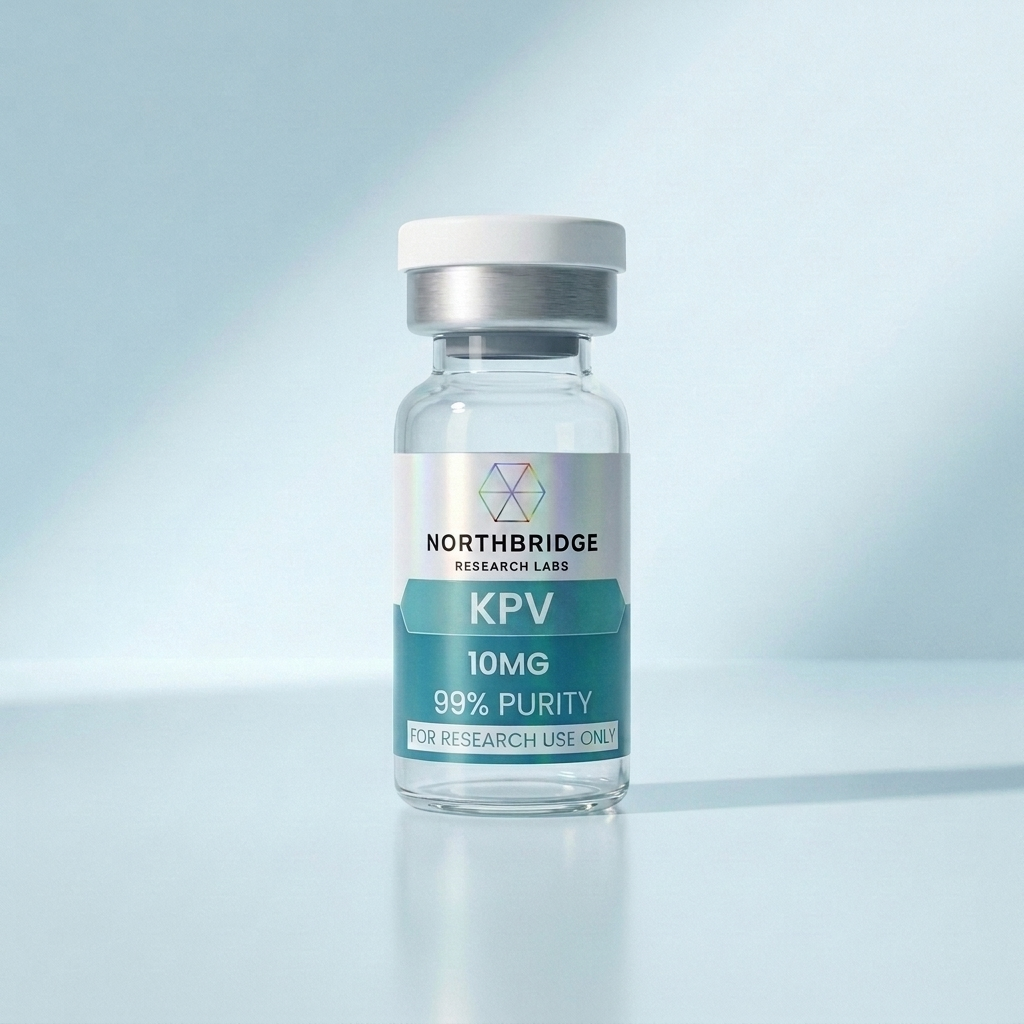
Certificate of Analysis
Each batch of KPV undergoes rigorous third-party testing to ensure purity and identity verification. View the full lab report below.
KPV (Lysine-Proline-Valine)
KPV is a naturally occurring anti-inflammatory tripeptide derived from alpha-melanocyte stimulating hormone (α-MSH). This C-terminal fragment represents the minimal active sequence responsible for α-MSH's potent anti-inflammatory and antimicrobial properties, making it valuable for inflammation and immune research.
99%+
10mg
Bundle & Save
Order before 2 PM EST, ships the same day. Fast, fully tracked, and sent in discreet, secure packaging. Free shipping on orders over $99.
Purity Guarantee. If independent third-party testing doesn't confirm our stated purity standards, you get a full refund plus a free replacement.
For Research Use Only
Intended for in-vitro research only. Not for human consumption. Must be 21+.
Specifications
Certificate of Analysis
Each batch of KPV undergoes rigorous third-party testing to ensure purity and identity verification. View the full lab report below.
Research background
KPV: Alpha-MSH Fragment for Inflammation Research
KPV (Lys-Pro-Val) is the C-terminal tripeptide of alpha-MSH. A research guide to how it enters cells through PepT1, how it blocks NF-κB nuclear import, what the colitis and inflammation models showed, the unresolved melanocortin-receptor question, and practical notes for the lab.
Overview
Biochemical Characteristics
KPV corresponds to amino acids 11-13 of α-MSH. Unlike full-length α-MSH, this tripeptide exerts anti-inflammatory effects through melanocortin receptor-independent pathways, enabling studies of direct NF-κB inhibition in experimental models.
Research Applications
Pathway / Mechanistic Context
Preclinical Research Summary
Form & Analytical Testing
Mechanisms of Action
NF-κB Inhibition - Blocks nuclear translocation and DNA binding of NF-κB transcription factors
Cytokine Modulation - Reduces production of pro-inflammatory cytokines TNF-α, IL-1β, IL-6, and IL-8
Antimicrobial Activity - Inhibited Staphylococcus aureus and Candida albicans in vitro, with a cAMP-linked mechanism proposed
Receptor-Independent Action - Acts through non-melanocortin receptor pathways unlike parent α-MSH
Research Applications
1Inflammation & Immune Research
Primary research focus on anti-inflammatory mechanisms and immune modulation.
Key Research Findings
- Reduces inflammatory cytokine production in cell models
- Inhibits NF-κB nuclear translocation in multiple cell types
- Decreases neutrophil infiltration in inflammation models
- Investigated for effects on macrophage inflammatory signaling
2Gastrointestinal Research
Studies on intestinal inflammation and mucosal protection.
Key Research Findings
- Reduces inflammation in experimental colitis models
- Protects intestinal epithelial barrier function
- Decreases inflammatory cytokines in gut tissue
- Supports mucosal healing in injury models
3Antimicrobial Research
Investigation of direct antibacterial properties.
Key Research Findings
- Demonstrates bactericidal activity against multiple species
- Disrupts bacterial membrane integrity
- Inhibited Staphylococcus aureus and Candida albicans in vitro
- Potential dual anti-inflammatory and antimicrobial effects
Supporting Research & Bibliography
The following peer-reviewed publications support the research applications described above. References are provided for informational purposes to assist researchers in their literature review.
Total references: 4
Note: The information provided is for research reference only. It summarizes published in-vitro, animal and, where cited, human clinical studies of the compound; findings from those studies are not claims about this product. This product is intended for laboratory research purposes only. Not for human or veterinary use.
Research Use Only: This product is intended for laboratory research purposes only. Not for human or veterinary use. By purchasing, you confirm that you are a qualified researcher and will use this product in accordance with all applicable regulations.