🔥 25% OFF with code NB25NOWSame Day ShippingFREE Shipping Over $99🔥 25% OFF with code NB25NOWSatisfaction Guaranteed🔥 25% OFF with code NB25NOWSame Day ShippingFREE Shipping Over $99🔥 25% OFF with code NB25NOWSatisfaction Guaranteed🔥 25% OFF with code NB25NOWSame Day ShippingFREE Shipping Over $99🔥 25% OFF with code NB25NOWSatisfaction Guaranteed🔥 25% OFF with code NB25NOWSame Day ShippingFREE Shipping Over $99🔥 25% OFF with code NB25NOWSatisfaction Guaranteed
HomeProductsAOD-9604
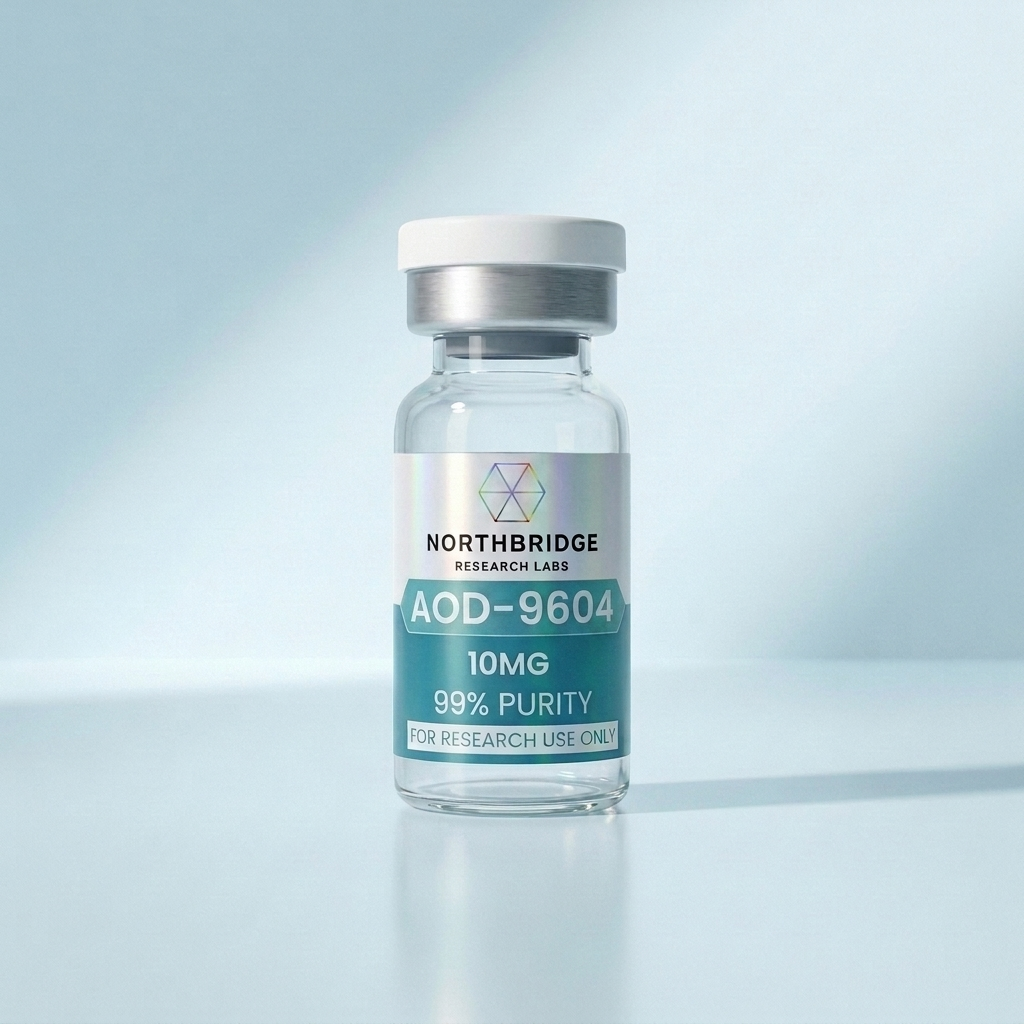
AOD-9604
Metabolic Research

AOD-9604

$89.00In StockChecking availability...

Anti-Obesity Drug 9604 is a modified fragment of human growth hormone (HGH fragment 177-191). This peptide is researched for its effects on lipid metabolism in laboratory settings.

Purity

99%+

Size

10mg

1
COA Available
Lab Verified
Fast Shipping
!

For Research Use Only (RUO)

This product is intended for in-vitro research applications only. Not for human or animal consumption, cosmetic use, or as a dietary supplement. All customers must be at least 21 years of age. It is the researcher's responsibility to handle materials in accordance with their institution's safety protocols and all applicable laws.

Specifications

Molecular Weight1,817.12 Da
SequenceHGH Fragment 177-191
AppearanceWhite lyophilized powder
StorageStore at -20°C
SolubilitySoluble in sterile water

Certificate of Analysis

Each batch of AOD-9604 undergoes rigorous third-party testing to ensure purity and identity verification. Download your COA instantly.

HPLC Purity Analysis
Mass Spectrometry Verification
Lot-Specific Documentation

Extended Research Applications & Mechanisms

Overview

AOD-9604 is a modified synthetic peptide fragment derived from amino acids 177-191 of human growth hormone, with a tyrosine residue at position 177. This research-grade peptide retains the lipolytic properties of the parent hormone while lacking effects on IGF-1 elevation or glucose metabolism. AOD-9604 is utilized in laboratory research to study lipid metabolism, adipocyte biology, and metabolic signaling pathways. All discussion herein is limited to experimental research contexts and does not imply applied, therapeutic, or physiological use.

Biochemical Characteristics

Sequence: Tyr-Leu-Arg-Ile-Val-Gln-Cys-Arg-Ser-Val-Glu-Gly-Ser-Cys-Gly-Phe
Molecular Formula: C₇₈H₁₂₅N₂₃O₂₃S₂
Molecular Weight: 1817.12 g/mol
CAS Number: 221231-10-3

AOD-9604 represents the C-terminal fragment of human growth hormone with an added N-terminal tyrosine. The disulfide bond between the two cysteine residues maintains structural integrity and biological activity in experimental models.

Research Applications

AOD-9604 is employed in laboratory research to study lipolytic mechanisms and adipocyte biology. Common experimental applications include lipid metabolism assays, adipocyte differentiation studies, and metabolic pathway investigations. Research protocols utilize AOD-9604 to investigate the structure-activity relationship of growth hormone fragments, particularly the mechanism by which the C-terminal region promotes lipolysis without affecting growth or glucose metabolism.

Pathway / Mechanistic Context

Mechanistically, AOD-9604 stimulates lipolysis through activation of hormone-sensitive lipase (HSL) in adipocytes. Unlike full-length growth hormone, this fragment does not bind to growth hormone receptors or stimulate IGF-1 production, resulting in selective metabolic effects. The peptide interacts with β3-adrenergic signaling pathways to enhance cAMP production and subsequent PKA activation, leading to HSL phosphorylation and triglyceride hydrolysis. This mechanism operates independently of the GH-IGF-1 axis.

Preclinical Research Summary

Preclinical investigations of AOD-9604 include in-vitro adipocyte studies and in-vivo animal models evaluating lipid metabolism. Reported findings include enhanced lipolysis without effects on linear growth, glucose tolerance, or IGF-1 levels. Animal studies explore effects on body composition, demonstrating selective reduction in adipose tissue mass without altering lean body mass. All findings are interpreted strictly within the context of laboratory research models.

Form & Analytical Testing

AOD-9604 is supplied as a synthetic research-grade lyophilized peptide. Identity and purity are confirmed through analytical methodologies including high-performance liquid chromatography (HPLC) and mass spectrometry (MS). Batch-specific documentation includes certificate of analysis data supporting molecular identity and purity metrics ≥98%.

Mechanisms of Action

1

Lipolytic Activation - Stimulates adipocyte triglyceride hydrolysis through hormone-sensitive lipase

2

Beta-3 Adrenergic Modulation - Interacts with β3-adrenergic receptor signaling pathways

3

IGF-1 Independent - Does not elevate insulin-like growth factor-1 levels unlike full-length GH

4

Glucose Neutral Profile - No significant effects on blood glucose homeostasis or insulin sensitivity

Research Applications

1Lipid Metabolism Research

Studies on fat metabolism and adipose tissue biology.

Key Research Findings
  • Stimulates lipolysis in adipocytes through HSL activation
  • Reduces lipogenesis and fat accumulation in research models
  • Does not cause hyperglycemia or insulin resistance
  • Maintains normal IGF-1 levels unlike full-length GH

2Adipocyte Biology

Research on adipocyte function and differentiation.

Key Research Findings
  • Modulates adipocyte lipid storage and release
  • Affects preadipocyte differentiation pathways
  • Influences adipokine secretion patterns
  • Selective effects on white adipose tissue

3Metabolic Signaling Studies

Investigation of metabolic pathways and signaling cascades.

Key Research Findings
  • Activates β3-adrenergic signaling pathways
  • Increases cAMP and PKA activity in adipocytes
  • Does not activate growth hormone receptor
  • Useful for studying GH fragment structure-activity

Supporting Research & Bibliography

The following peer-reviewed publications support the research applications described above. References are provided for informational purposes to assist researchers in their literature review.

1

Increase of fat oxidation and weight loss in obese mice caused by chronic treatment with human growth hormone or a modified C-terminal fragment

Heffernan MA, Thorburn AW, Fam B, et al.

International Journal of Obesity2001;25:1442-1449DOIPubMed
2

Metabolic studies of a synthetic lipolytic domain (AOD9604) of human growth hormone

Ng FM, Sun J, Sharma L, et al.

Hormone Research2000;53:274-278DOIPubMed
3

Safety and tolerability of the hexadecapeptide AOD9604 in humans

Stier H, Vos E, Kenley D.

Journal of Endocrinological Investigation2013;36:574-579DOIPubMed
4

The effects of human GH and its lipolytic fragment (AOD9604) on lipid metabolism following chronic treatment in obese mice and beta(3)-AR knock-out mice

Heffernan M, Summers RJ, Thorburn A, et al.

Endocrinology2001;142:5182-5189DOIPubMed

Total references: 4

Note: The information provided is for research reference only. All research applications are based on in-vitro and animal studies. This product is intended for laboratory research purposes only. Not for human or veterinary use.

Research Use Only: This product is intended for laboratory research purposes only. Not for human or veterinary use. By purchasing, you confirm that you are a qualified researcher and will use this product in accordance with all applicable regulations.

Northbridge Research Labs | Buy Research Peptides Online