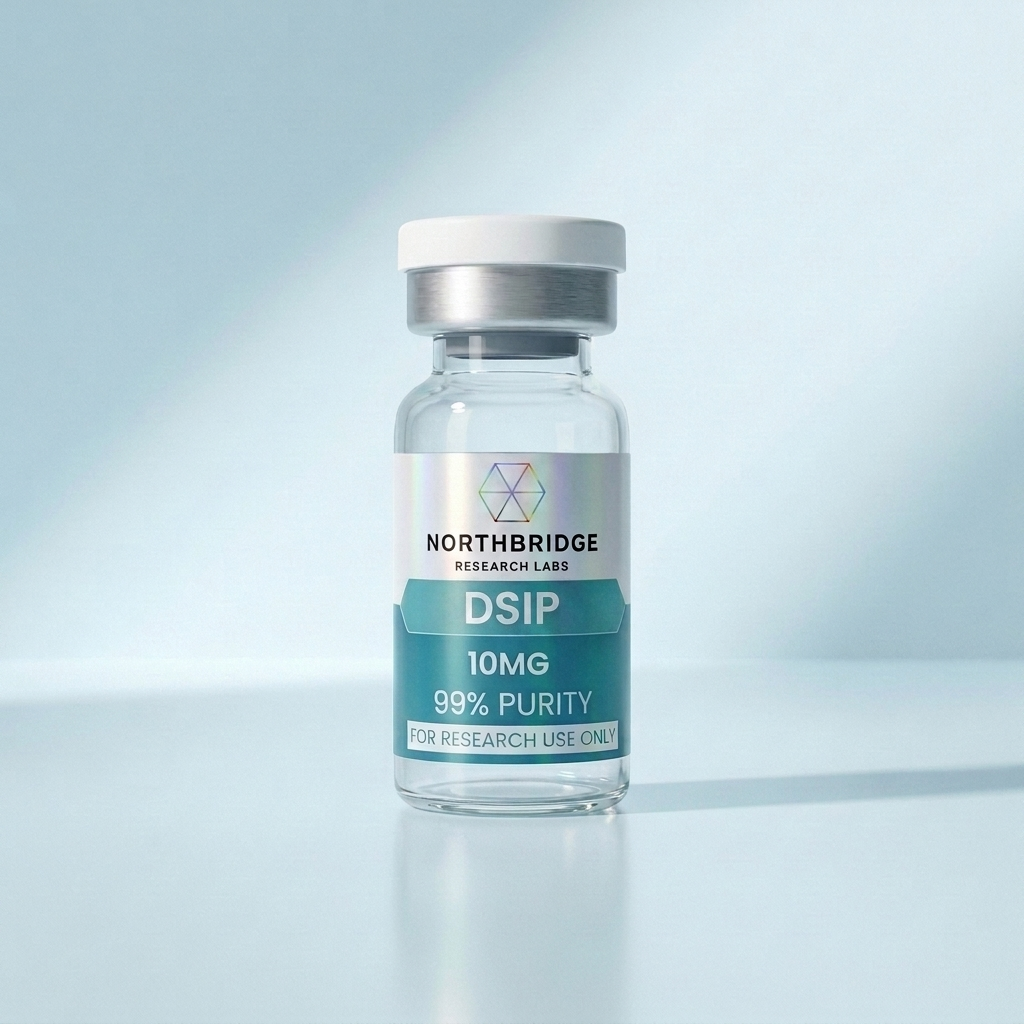
Certificate of Analysis
Each batch of DSIP undergoes rigorous third-party testing to ensure purity and identity verification. View the full lab report below.
DSIP (Delta Sleep-Inducing Peptide)
DSIP (Delta Sleep-Inducing Peptide) is a naturally occurring neuropeptide consisting of 9 amino acids. First isolated from rabbit brain tissue, this peptide is extensively studied for its role in sleep regulation, stress response modulation, and neuroendocrine function in laboratory research settings.
99%+
10mg
Bundle & Save
Order before 2 PM EST, ships the same day. Fast, fully tracked, and sent in discreet, secure packaging. Free shipping on orders over $99.
Purity Guarantee. If independent third-party testing doesn't confirm our stated purity standards, you get a full refund plus a free replacement.
For Research Use Only
Intended for in-vitro research only. Not for human consumption. Must be 21+.
Specifications
Certificate of Analysis
Each batch of DSIP undergoes rigorous third-party testing to ensure purity and identity verification. View the full lab report below.
Overview
Biochemical Characteristics
DSIP is a nonapeptide with an N-terminal tryptophan residue. Its amphipathic nature allows it to cross the blood-brain barrier and interact with central nervous system targets in experimental models.
Research Applications
Pathway / Mechanistic Context
Preclinical Research Summary
Form & Analytical Testing
Mechanisms of Action
Sleep Architecture Modulation - Promotes delta wave (slow-wave) sleep patterns in research models
GABA System Interaction - Modulates GABAergic neurotransmission and receptor sensitivity
Stress Response Regulation - Attenuates ACTH and cortisol release under stress conditions
Circadian Rhythm Influence - Interacts with hypothalamic nuclei involved in sleep-wake cycles
Research Applications
1Sleep Research & Chronobiology
DSIP is primarily studied for its effects on sleep architecture and circadian function.
Key Research Findings
- Increases delta wave (slow-wave) sleep duration in research models
- Reduces sleep onset latency in various experimental paradigms
- Normalizes disrupted sleep patterns in stress-induced models
- Modulates melatonin and growth hormone secretion rhythms
2Stress & Neuroendocrine Research
Research explores effects on HPA axis function and stress response.
Key Research Findings
- Attenuates ACTH and cortisol elevation under stress
- Normalizes hypothalamic-pituitary axis function in stress models
- Reduces anxiety-like behaviors in research models
- Improves stress resilience markers in animal models
3Pain & Opioid System Research
Studies indicate interactions with pain perception pathways.
Key Research Findings
- Demonstrates analgesic properties in nociceptive assays
- Enhances endogenous opioid system function
- Reduces inflammatory pain markers
- Potentiates effects of opioid compounds in research
Supporting Research & Bibliography
The following peer-reviewed publications support the research applications described above. References are provided for informational purposes to assist researchers in their literature review.
Total references: 3
Note: The information provided is for research reference only. It summarizes published in-vitro, animal and, where cited, human clinical studies of the compound; findings from those studies are not claims about this product. This product is intended for laboratory research purposes only. Not for human or veterinary use.
Research Use Only: This product is intended for laboratory research purposes only. Not for human or veterinary use. By purchasing, you confirm that you are a qualified researcher and will use this product in accordance with all applicable regulations.